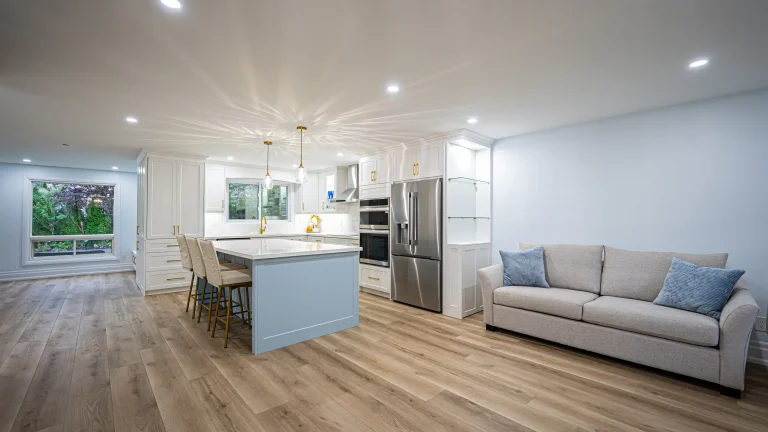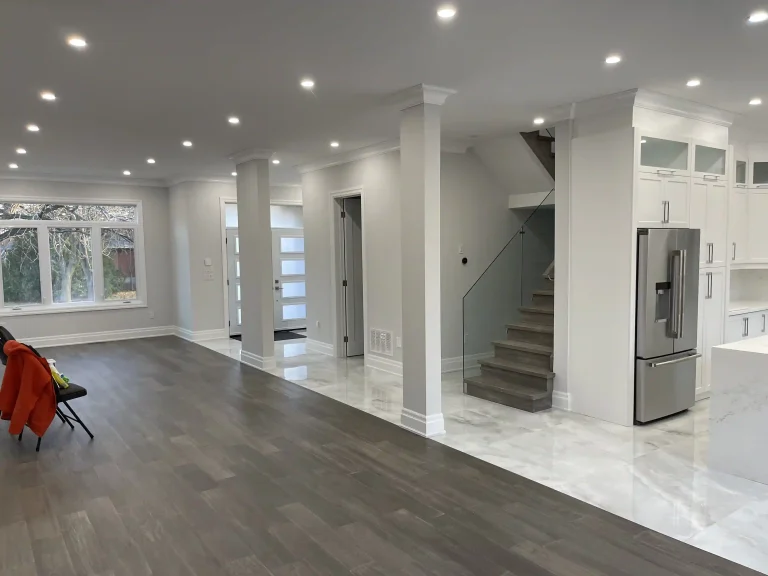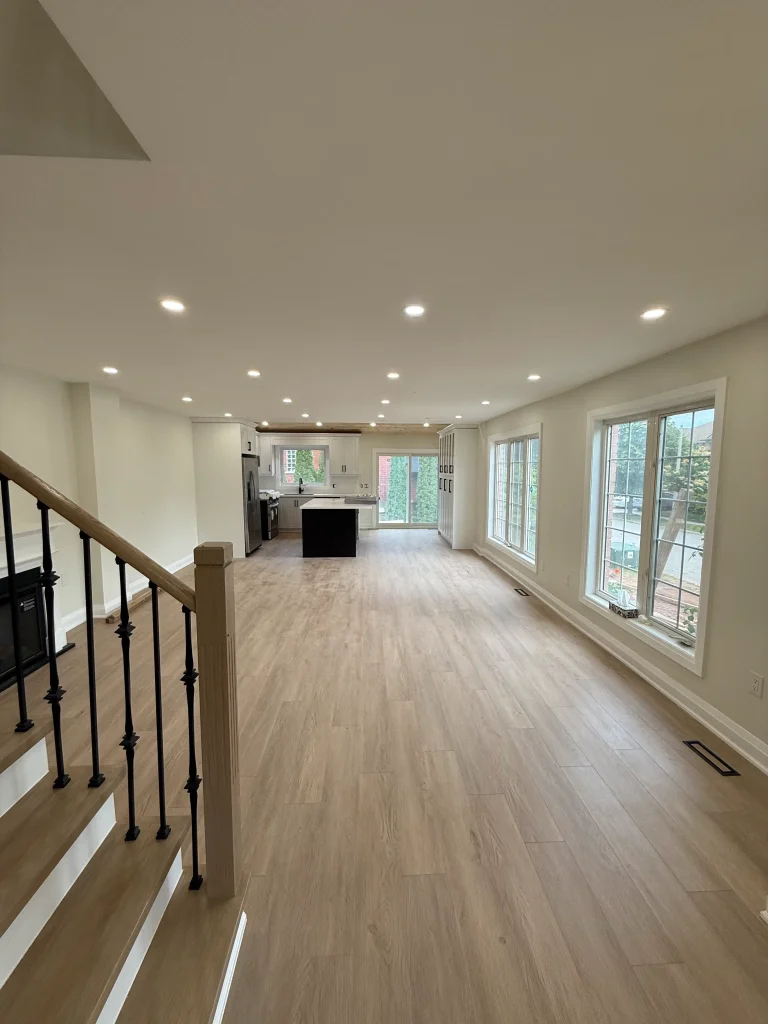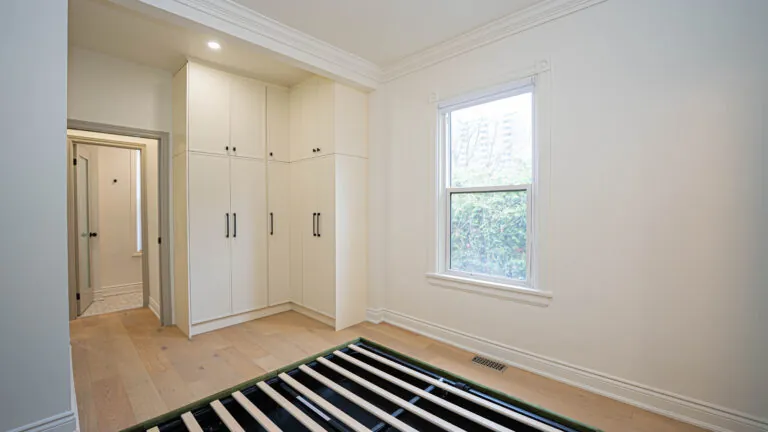
Most Ontario homeowners pay for a renovation with savings, a home equity line of credit (HELOC), a mortgage refinance, or a mix of these. Our rule of thumb: use cash under $50,000, use a HELOC drawn at each payment milestone from $50,000 to $150,000, and use a refinance timed to your mortgage renewal over $150,000. Personal loans and payment plans cost more, so they only make sense for small jobs or homes with little equity.
- A standalone HELOC can go up to 65% of your home's value. All borrowing secured by the home usually tops out at 80% combined.
- Big-bank prime is 4.70% since October 29, 2026. A HELOC priced at prime plus 0.50% costs 5.20%, and the rate moves every time the Bank of Canada does.
- A HELOC only charges interest on what you've drawn. Drawing at each milestone instead of all at once saves real money.
- Ontario law has you hold back 10% of each payment, so you never need the full contract price on day one.
- Adding a legal secondary suite can qualify you for an insured refinance up to 90% of the home's value.
The five ways to pay, side by side
Each option suits a different situation. Here is how they compare.
| Option | How the money arrives | Rate basis | Best for | Watch out for |
|---|---|---|---|---|
| Cash / savings | Already in hand | No interest, but you give up what the savings would have earned | Projects under $50K, deposits | Draining your emergency fund |
| HELOC | Draw any amount, any time, up to your limit | Variable, priced off prime | $50K to $150K, staged payments | Rate increases, interest-only habits |
| Mortgage refinance | Lump sum at closing | Fixed or variable mortgage rate | Over $150K, additions, whole-home | Prepayment penalty mid-term, legal and appraisal fees |
| Personal loan / unsecured line | Lump sum or line | Higher than secured borrowing | Small jobs, little home equity | Cost adds up on bigger amounts |
| Contractor or retailer payment plan | A third-party lender pays the contractor | Promo rate, then the standard rate | Single items, short payback | The rate after the promo ends |
How much you can borrow: the 65% and 80% rules
The Financial Consumer Agency of Canada sets out the limits federally regulated lenders follow. A HELOC can go up to 65% of your home's appraised value. All home equity borrowing combined, mortgage included, usually tops out at 80%. When a HELOC is bundled with a mortgage, anything above the 65% revolving portion has to be paid down on a schedule, like a regular mortgage.
A quick example. Your home appraises at $1,200,000 and you owe $500,000. Eighty percent of the value is $960,000, so you have about $460,000 of room before the lender checks your income and runs the stress test. If the house is paid off, a standalone HELOC caps at 65%, or $780,000 on that home.
Most people never get close to these limits on a kitchen or bathroom. The limits start to matter on additions and whole-home projects, and for owners who bought recently with a small down payment.
What it costs at today's rates
On October 28, 2026, the Bank of Canada raised its policy rate to 2.5%, and said further increases may be needed. It was the first hike since July 2023. All six of the big banks moved prime to 4.70% right after. The next rate decision is December 9, 2026, so anyone planning a 2027 project on a variable line should budget for another move.
If your bank prices your HELOC at prime plus 0.50%, you pay 5.20%. Interest-only on $100,000 at that rate is about $433 a month. Each 0.25% increase adds about $21 a month per $100,000 borrowed. That's manageable, but a variable rate needs some room in your budget.
Why draw timing matters
A HELOC only charges interest on the balance you've drawn. Here is a $100,000 project over four months at 5.20%:
| Approach | Balance during the project | Interest over 4 months |
|---|---|---|
| Draw everything on day one | $100K every month | About $1,733 |
| Draw at each milestone | $25K, $50K, $75K, $90K (10% held back) | About $1,040 |
A refinance gives you the full lump sum at closing, so you pay interest on all of it from day one. On a short project the gap is small. On a nine-month addition it grows.
Matching your financing to the contractor's payment schedule
Renovation contracts are paid in stages, not all at once. A typical schedule looks like this:
- A deposit at signing, which covers design time, permit drawings and long-lead orders like cabinetry.
- Progress payments at milestones such as demolition and rough-ins, passed inspections, drywall, and cabinet or tile install.
- A final payment at substantial completion.
- Release of the holdback once the lien period has passed.
Under Ontario's Construction Act, homeowners must hold back 10% of each payment as the work is done, which protects you if a subcontractor or supplier goes unpaid. The holdback stays in place until the lien period ends, which is generally 60 days from completion or from publication of a certificate of substantial performance. In practice, you don't need the last 10% of your financing until about two months after the work wraps up.
We'd pay the deposit from cash and draw each later payment from the HELOC when the invoice arrives. If you're refinancing, close before demolition so no payment is waiting on the bank.
Our recommendation by project size
| Project size | Typical Gracia projects (before HST) | What we'd use |
|---|---|---|
| Under $50K | Powder room $7K to $20K, main bath $28K to $40K, smaller basements from $25K | Cash first, HELOC second |
| $50K to $150K | Kitchens $40K to $140K+, ensuites $35K to $55K, basements up to $100K+ | HELOC drawn per milestone, cash deposit |
| Over $150K | Additions $120K to $350K+, whole-home $100K to $250K+ | Refinance at renewal, or a HELOC rolled into the refinance |
Under $50,000
If the money is in savings and you'll still have an emergency fund afterward, pay cash. Setting up a HELOC for a $20,000 powder room means an appraisal and paperwork to save very little interest. If you need to borrow, a HELOC still beats a personal loan on rate. Use a personal loan or a payment plan only if you have little equity, and work out the full cost after any promo period ends.
$50,000 to $150,000
This is where a HELOC works best. Most kitchen renovations and finished basements land in this range. Don't forget HST. An $80,000 kitchen before tax is $90,400 with 13% HST. Set up the line before you sign, not after demolition. Then pick a payoff plan, say 24 to 36 months, so the balance doesn't sit for years on interest-only payments.
Over $150,000
Additions and major whole-home renovations are where a refinance usually pays off. Interest-only on $250,000 at 5.20% is about $1,083 a month with no principal coming off. A refinance spreads the principal over your amortization. Time it to your renewal if you can, because breaking a mortgage mid-term can cost a large penalty. If renewal is a year away, many owners start on a HELOC and roll the balance into the new mortgage at renewal.
The exception: legal basement apartments and secondary suites
A standard refinance stops at 80%. If you're building a self-contained secondary suite, CMHC Refinance allows insured borrowing up to 90% of the home's value once the suite is built. The as-improved value has to be under $2 million, amortization can run up to 30 years, the property can have up to four units, and the suite can't be rented short-term. A mortgage insurance premium applies. The money has to go toward building the suite, so this works for legal basement apartments, not a general kitchen update.
What we see on site
- Financing approved late. Appraisals and approvals take time. Get approval in writing before you sign the contract, so a delay at the bank doesn't hold up the trades.
- Maxing out the line. We open walls and find rot, old wiring or a cast iron drain that needs replacing. We'd leave about 10% of the project value unused on the line as a contingency.
- Forgetting HST. Quotes and price ranges are often shown before tax. Borrow for the after-tax total.
- Mixing up holdback and deficiencies. The 10% holdback is a legal protection, not a fund for touch-ups. Keep deficiency items on a separate written list.
- Changes mid-project. Upgrading to a bigger island or different tile halfway through adds cost. Settle the scope before you finance, and get changes priced in writing before you agree to them.
- Planning around the minimum payment. A HELOC lets you pay interest only. Treat it as a short-term loan with a payoff date.
Your next step
Your financing is only as good as your budget, so start with scope and price, then talk to your lender. Our pages on home renovations in Oakville and home renovations in Burlington show what projects there involve. If an addition is on the table, our home additions page explains what drives the cost, so you walk into the bank with a number you can rely on.