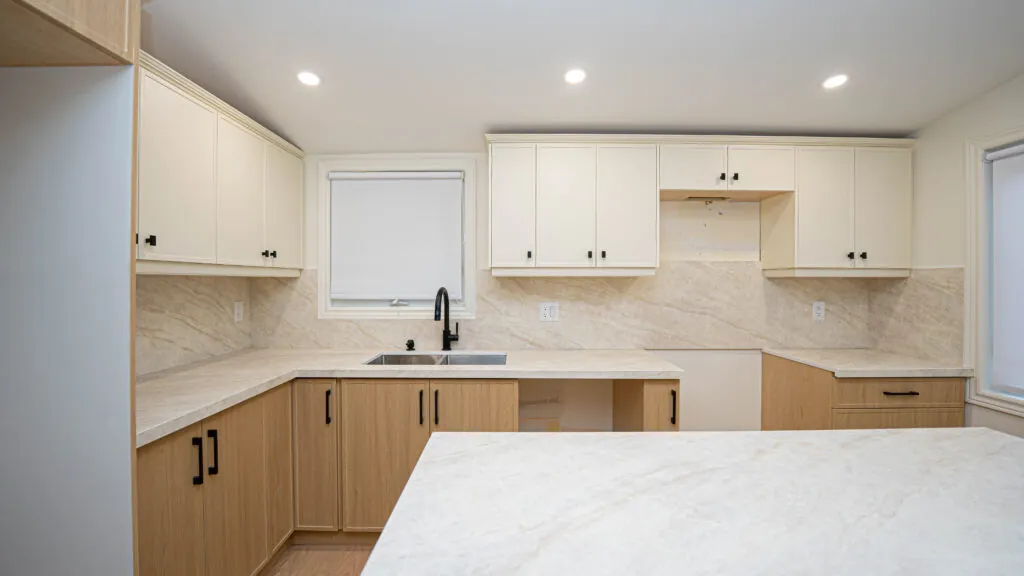
A good renovation contract in Ontario lists the exact scope of work, attaches drawings and a written estimate, and ties each payment to a stage you can inspect. It should ask for a small deposit (the province recommends about 10%) and leave room for the 10% holdback the Construction Act requires. It also needs signed change orders, proof of insurance, and a written warranty with a start date and a claim process.
- If a written estimate is part of the contract, the final price can't go more than 10% over it unless you agree in writing to new work or a new price.
- Keep the deposit near 10%. A request for 30% to 50% up front is a red flag.
- Hold back 10% of every payment. Release it only after the lien period ends and your title is clear.
- Vague scopes cause more disputes than anything else. Model numbers, allowances and exclusions belong on paper.
- Check the insurance certificate, the WSIB clearance and the warranty terms yourself before work starts.
What Ontario law already gives you
Some protection is already written into provincial law. Ontario's page on your rights when starting home renovations or repairs says that when an estimate is part of a home renovation contract, the final price can't be more than 10% over it unless you've agreed to new work or a new price. So attach the estimate to the contract. Don't leave it in a separate email.
The same page says a renovation contract worth $50 or more signed in your home comes with a 10-calendar-day cooling-off period. You can cancel for any reason in that window, and there's no fee. Ontario's door-to-door and home service contracts page adds that if you never got a written contract, or it's missing required information, you can cancel within one year.
You may have heard about a new consumer law. The Consumer Protection Act, 2023 has passed, but e-Laws still lists it as not yet in force. The 2002 Act still covers contracts signed today.
Scope, allowances and change orders
The scope is the most important part of the contract. Anything that isn't written down will be remembered differently by you and the contractor. A solid scope for a kitchen, bathroom or whole-home renovation includes:
- Drawings, plus a finish schedule with brands, model numbers and colours
- Demolition, disposal, dust protection and daily cleanup
- Who applies for the building permit and who books the inspections
- Electrical, plumbing and HVAC work described room by room
- Drywall finish level, number of paint coats and trim profile
- A start date, an approximate finish date, and what "substantially complete" means
Allowances
An allowance is a placeholder budget for something you haven't chosen yet, such as tile at $8 per square foot. Allowances are fine as long as they're realistic and the contract explains how overages are billed. A low allowance makes a quote look cheap today and costs you later. If every finish in a quote is an allowance, you don't have a real price yet.
Exclusions
A good contract lists what isn't included. Common exclusions are asbestos or vermiculite abatement, knob-and-tube replacement, hidden rot, structural repairs, appliance supply and window coverings. Exclusions aren't a trick. They show you where the risk sits, so you can set aside a contingency for it.
Change orders
Every change gets a written change order before the work is done. It shows what's changing, the price and the extra days, and you both sign it. That's also how you keep the 10% estimate protection intact. Most end-of-job disputes we see started as verbal "while you're here" extras.
Deposits and the payment schedule
Ontario's consumer guidance says to keep down payments to a minimum, with 10% recommended, and never pay the full amount before the work is done. It also notes that legitimate renovation companies have enough credit to buy their own materials.
Tie each payment after the deposit to a stage you can see. Here's a sample schedule for an $80,000 kitchen, which sits inside our published kitchen renovation range of $40,000 to $140,000+ before HST:
| Stage | Share of contract | Amount (before HST) | Check before paying |
|---|---|---|---|
| Signing deposit | 10% | $8,000 | Signed contract, drawings, finish schedule |
| Rough-ins complete | 25% | $20,000 | Rough-in inspections passed |
| Drywall and cabinets installed | 30% | $24,000 | Cabinets match the order, doors adjusted |
| Countertops and backsplash | 20% | $16,000 | Seams, overhangs, sink cut-out |
| Substantial completion | 15% | $12,000 | Walkthrough done, deficiency list signed |
You keep 10% of each progress invoice as the statutory holdback, covered in the next section. In this example that adds up to about $8,000, paid as the last cheque once the lien period is over. Ontario's prompt payment rules also apply. A summary of the Act explains that an owner has to pay a proper invoice within 28 days, or give a notice of non-payment within 14 days. Read each invoice as soon as it comes in.
The 10% holdback under the Construction Act
Many homeowners have never heard of this rule. Ontario's Construction Act requires owners to hold back 10% of what they pay for services and materials. That money protects you if a subcontractor or supplier doesn't get paid. If you hire a contractor directly, the Act treats you as the owner.
The holdback period follows the lien deadlines. Someone who wasn't paid has 60 days to preserve a lien by registering it on your title, then 90 more days to perfect it with a court action. On most home jobs there's no published certificate of substantial performance, so the 60 days start when the contract is completed, abandoned or terminated. The most common mistake is paying the holdback early because the job looks finished. If the drywall sub was never paid, they can still register a lien on your house.
What changed in 2026
Amendments that came into force January 1, 2026 require owners to publish a notice of annual release of holdback within 14 days of each one-year anniversary of the contract. According to Cassels, annual release is now mandatory on contracts that last longer than one year. Most kitchens and bathrooms finish well within a year, so this mostly affects large additions and full rebuilds.
Another change matters on every job. The 2026 amendments removed the owner's notice of non-payment of holdback. In practice, the holdback isn't your deficiency fund. Handle unfinished items with a signed deficiency list and a separate amount you both agree on. On anything large, ask a lawyer how the holdback rules apply to your contract.
Insurance and WSIB
Ask for a certificate of liability insurance that shows the company's legal name and expires after your project ends. Call the broker listed on it to confirm it's active. Ask your own home insurer whether you need to report the renovation, especially if walls are opening up or the house will be empty for a while.
On WSIB, the WSIB clearance FAQ says a clearance certificate isn't required when the person living in the home, or a family member, hires a contractor for repairs or renovations. We'd still ask for one. You can check the number for free online, and a valid clearance shows the company is registered and paying premiums for its crew. If you're renovating a rental unit you don't live in, that exemption doesn't apply, so get the certificate before work starts.
Warranty terms worth reading twice
A warranty clause should say how long coverage lasts, when it starts (usually at substantial completion), what it covers and how to make a claim. There are two kinds:
| Warranty type | Who stands behind it | Typical coverage |
|---|---|---|
| Workmanship | Your contractor | Installation problems: leaking fittings, tile cracking from poor setting, doors out of adjustment |
| Manufacturer | The product maker | Defects in faucets, appliances, flooring and cabinet hardware |
Ask for the manufacturer warranty documents and registration cards at handover. Some products have to be registered for full coverage. Gracia gives a 4-year workmanship warranty. If a contractor offers less than one year, ask why. Some exclusions are normal: hairline drywall cracks from seasonal movement, wood shrinking in a dry winter, and damage from misuse.
Red flags and what to verify before signing
Red flags
- A deposit well above 10%, or cash only
- A one-page quote that just says "kitchen reno, all-in" with no drawings or model numbers
- Every finish written as an allowance
- "You don't need a permit for this" on work that moves plumbing, wiring or walls
- No mention of the holdback, or a clause saying you pay 100% on completion
- Pressure to sign today to keep the price
- No business address, or a company name that doesn't match the insurance certificate
Verify before you sign
- The legal company name is the same on the contract, the insurance certificate and the WSIB clearance.
- The written estimate and drawings are attached to the contract.
- Payments are tied to stages, not calendar dates.
- The contract says who handles permits and inspections.
- The change order process is written out, including how changes affect the schedule.
- The warranty length, start date and claim process are in writing.
- You've spoken to recent references for similar projects.
For bigger jobs, like a legal basement apartment or a home addition, an hour with a lawyer before you sign costs little and can save a lot.
What we see on site
The contract problems our crews run into are predictable:
- Opening walls. Older homes in Oakville and Burlington hide surprises like undersized joists, old galvanized pipe and ungrounded circuits. A contract with an "unforeseen conditions" clause and a set unit or hourly rate keeps these calm. Without one, every surprise turns into a negotiation.
- Late finish selections. If you pick tile or a vanity after demolition, lead times hold up the trades. We want every selection locked in before demo day.
- Hallway changes. A homeowner asks the electrician for two more pot lights, and the charge shows up on the final bill. Every extra goes on a signed change order, even a $200 one.
- No deficiency list. At substantial completion, walk through together, write down every item, and both sign. That list, not the holdback, is what gets the last items done.
- Holdback paid on move-in day. Put the end of the lien period in your calendar. Pay the holdback once it passes and a title search shows no liens.
To see what a detailed scope and a staged payment schedule look like on a real project, our pages on home renovations in Oakville and home renovations in Burlington explain how one team handles design, permits and every trade under a single contract. Once you have a rough plan, you can book a consultation and we'll go through a sample contract with you line by line.