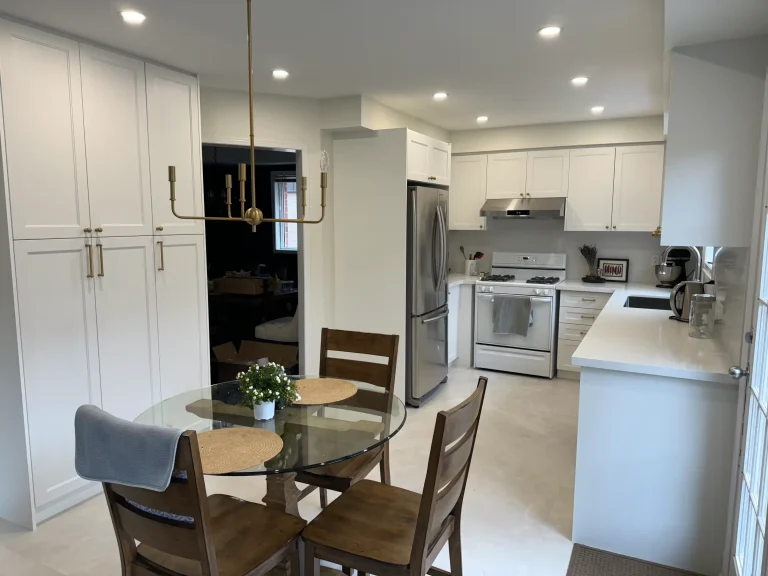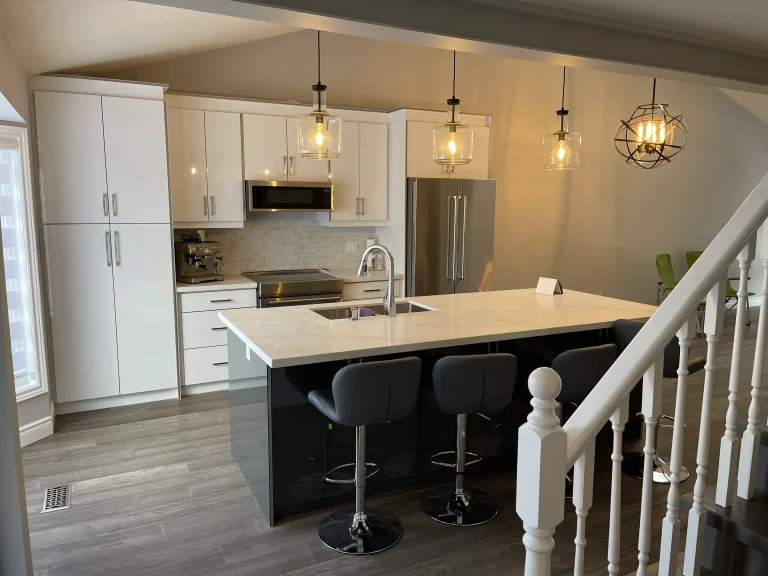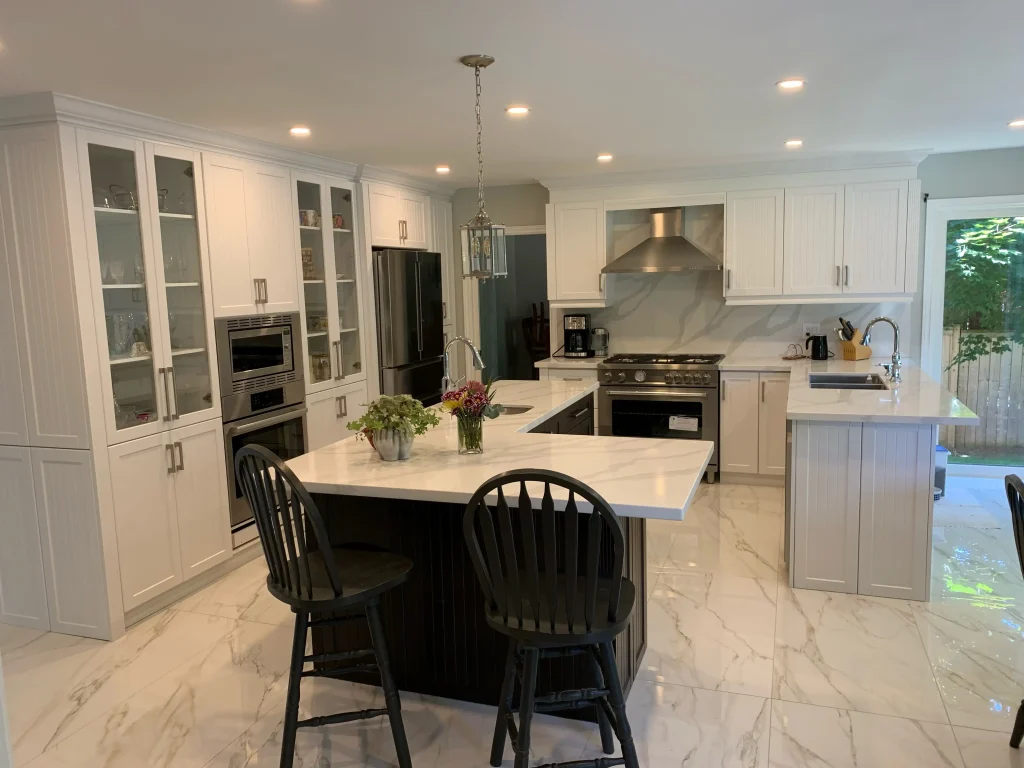
For most Ontario kitchens, semi-custom cabinets give the best value. You get standard sizes, many more finishes and interior options than stock, and a shorter wait than custom. Buy stock for rentals, basement units and tight budgets. Buy custom when the room has 9- or 10-foot ceilings, out-of-square walls or built-ins that standard boxes can't fit.
- Stock: widths step up in 3-inch increments, you can usually get them within days, and finishes are limited. Best for rentals, basement units and laundry rooms.
- Semi-custom: standard sizes with far more finishes and interiors, plus some modifications. This is our default for a typical GTA or Hamilton kitchen.
- Custom: built to fit the room in any species or colour, with the longest lead time. Worth it with tall ceilings, crooked walls and built-ins.
- What the box is made of and the hardware matter more than the tier name. A well-built semi-custom plywood box beats a poorly built "custom" one.
- Since July 31, 2026, many imported wood cabinets have carried a provisional 25% federal surtax. Ask where your boxes and doors are made.
The three tiers in plain terms
Stock cabinets are mass-produced in set sizes and held in a warehouse. Home Depot Canada's buying guide says stock cabinets usually come in 3-inch width steps from 12 to 60 inches. They come either assembled or ready-to-assemble (RTA).
Semi-custom cabinets come from a manufacturer's catalogue but aren't built until you order. Widths are usually the same as stock. What changes is the choice: more door styles, paint and stain colours, pull-outs, dividers and organizers. Many lines also let you reduce depth, extend height or add finished end panels for a fee.
Custom cabinets are built for your room. Every width, height and depth comes from measurements taken on site. Most custom shops now cut on CNC machines, so custom doesn't mean hand-carved. It means you're not limited to a catalogue.
None of these labels are regulated. One supplier's "semi-custom" can be another supplier's "custom." Judge a quote by what it includes, not by what it's called.
Side-by-side comparison
| Factor | Stock | Semi-custom | Custom |
|---|---|---|---|
| Relative cost | Lowest | Mid-range | Highest |
| Lead time | Days, often same-day in store | Weeks (built to order) | Nine weeks or more is common |
| Width sizing | 3-inch steps, gaps closed with fillers | Mostly 3-inch steps, some modifications | Any size, scribed to the walls |
| Typical box | Particleboard or melamine | Melamine, plywood optional | Your choice, plywood is common |
| Finishes | A few colours, thermofoil, melamine | Catalogue paints, stains, some veneers | Any colour, species or veneer |
| Best for | Rentals, basement units, laundry | Standard 8- to 9-foot kitchens | Tall ceilings, odd rooms, built-ins |
The lead times come from the same Home Depot Canada guide. It notes that semi-custom takes longer than stock, custom can take nine weeks or more, and custom can be built in increments as small as 1/32 inch.
Cost: where the money actually goes
Gracia kitchen renovations run $40,000 to $140,000+ before HST. Cabinets are one of the main things that decide where a project lands in that range. Moving up a tier also raises costs outside the boxes themselves. Custom work usually means more panels, finished ends, crown details and integrated appliances, and each of those adds labour.
Upgrades on a semi-custom order add up fast. Painted doors, finished end panels, roll-outs and taller uppers each cost extra. A semi-custom kitchen with lots of options can end up close to the price of a simple custom kitchen. Price both before you decide.
The 2026 tariff factor
Ottawa brought in a 25% surtax on certain imported wood cabinets and vanities on July 31, 2026, for up to 200 days. It covers boxes, doors, drawers and panels, finished or unfinished, assembled or RTA. Goods from the US, Mexico, Chile, Israel and certain developing countries are exempt, as is hardware imported on its own. The Canadian International Trade Tribunal held public hearings in October and is expected to report by January 15, 2027. If it finds no injury to Canadian makers, the surtax ends on that date. If it does, longer-term measures could follow. Imported budget lines are hit hardest. If your quote includes imported cabinets, ask whether the price already includes the surtax.
Sizing flexibility: fillers vs scribing
This is where the tiers really pull apart. Take a wall that's 143 inches long. Stock cabinets in 3-inch steps cover 141 inches, and the last 2 inches get a filler strip. One or two fillers are fine. Six fillers plus a 9-inch base nobody can use look like a compromise, because that's what they are.
Ceiling height matters even more. According to Home Depot Canada, standard base cabinets are 34-1/2 to 36 inches tall and 24 inches deep. Wall cabinets are 12 to 18 inches deep and up to 42 inches tall. Here's the math:
- A 36 in. counter plus an 18 in. backsplash puts the bottom of the uppers at 54 in.
- A 42 in. upper then tops out at 96 in., which is exactly 8 feet.
- With a 9-foot ceiling, that leaves a 12 in. gap. With a 10-foot ceiling, it's 24 in.
You can fill that gap with crown, a bulkhead, or leave it open, where it collects dust. The other option is a second row of uppers that runs to the ceiling. Some semi-custom lines offer stacked boxes. Custom builds them to the ceiling height measured in your house.
Construction quality: what to check at any tier
How long a cabinet lasts depends on what it's made of, not what it's called. Check these on every quote:
- Box material. Melamine-faced particleboard is fine in dry areas but swells if the sink leaks. Plywood holds screws better and stands up to water better. Our plywood vs melamine guide compares the two in detail.
- Hinges and slides. Look for full-extension soft-close slides and name-brand hinges such as Blum, Hettich or Grass. Cheap slides are usually the first thing to fail.
- Drawer boxes. Dovetailed solid wood or engineered metal-sided systems. Avoid stapled particleboard.
- Edge banding and backs. Tight, even banding on every visible edge, and backs thick enough to screw through into the wall.
- Emissions. Canada's composite wood regulations set formaldehyde limits for hardwood plywood (0.05 ppm), particleboard (0.09 ppm) and MDF (0.11 ppm). The limits apply to every tier, so ask for the compliance label.
Stock cabinets tend to save money on slides and drawer boxes. Semi-custom usually lets you upgrade both. With custom, you specify every part.
Finish and style options
Wood is back. In the NKBA's 2026 trends report, 59% of respondents said wood grain is gaining popularity, and 51% named white oak the top wood. The same report puts slab doors at 69% and panel-faced dishwashers at 85%. Houzz's 2026 US study found wood cabinets have overtaken white among homeowners who are renovating.
That affects which tier you need. Stock lines rarely offer true rift-cut white oak or walnut veneer, and grain matched from door to door is almost unheard of. Semi-custom catalogues often include oak and maple stains. For book-matched veneer, an exact Benjamin Moore colour or panels on a fully integrated fridge, you're usually looking at custom. If you're planning a white oak kitchen, compare real door samples from each tier side by side in daylight.
Which should you buy?
| Kitchen type | Budget priority | Our pick |
|---|---|---|
| Rental unit, legal basement apartment, flip | Lowest cost, quick replacement | Stock, ideally with a plywood sink base |
| 1990s to 2010s suburban home, 8- or 9-foot ceilings, square walls | Value and durability | Semi-custom with upgraded hardware |
| Open-plan kitchen that runs into a family room | A consistent look across the space | Semi-custom perimeter, custom island and built-ins |
| Older home (pre-1960) with uneven walls and floors | A proper fit | Custom |
| 10-foot ceilings, integrated appliances, wood veneer | Design-led | Custom |
Mixing tiers is often the smartest buy. The perimeter is mostly 30- and 36-inch boxes, which semi-custom handles well. Put the custom money into the island, hutch or coffee bar, where people actually look. For a legal basement apartment, a good stock kitchen is the right choice. Tenants need durability, not matched veneer.
Where custom millwork pays off, and where it doesn't
Worth it
- Tall ceilings. Uppers that run to a 9- or 10-foot ceiling give you storage instead of a dust shelf.
- Awkward spaces. Sloped ceilings, chimney breasts, angled walls, radiators and bulkheads you can't take out.
- Built-ins. Banquettes, butler's pantries, mudroom lockers and media walls in the same finish as the kitchen.
- Integrated appliances. Panel-ready fridges and dishwashers need panels and gaps sized to the appliance specs.
- Out-of-square rooms. Scribed end panels hide walls that are 3/4 inch out over 8 feet.
Not worth it
- A simple rectangular kitchen with 8-foot ceilings and freestanding appliances.
- Laundry rooms, garages and utility storage.
- Cabinet interiors. Spend on drawers and slides, not on custom shelf boxes.
- Rental units, where tenant wear will outlast any premium finish.
What we see on site
- Measure after drywall, not before. Drywall, plaster patches and corner bead can shift dimensions by 1/2 inch or more. Custom orders should go in only after a final site measure.
- Floors in older homes are rarely level. An inch of slope across a long run isn't unusual in older houses. Stock bases with fixed toe kicks make that hard to hide. Adjustable legs or a scribed custom toe kick solve it.
- Choose appliances first. Pick your models before ordering cabinets. Switching from a 36-inch range to a 30-inch one after ordering means a new filler or a reorder.
- Damage on delivery. A cracked stock door can often be replaced within a week. A custom painted door can take weeks, so build that into the schedule.
- Thermofoil beside wall ovens. Heat can lift thermofoil. Ask for heat shields, or use painted MDF or wood next to high-heat appliances.
If you're still deciding, our kitchen cabinet quiz narrows it down in a few minutes. Our custom kitchen cabinets page shows what we build. For a full budget that covers cabinets, counters and trades, use the estimator on our kitchen renovation page. To see cabinets we've built in local homes, visit our Oakville kitchen renovation and Burlington kitchen renovation pages.